
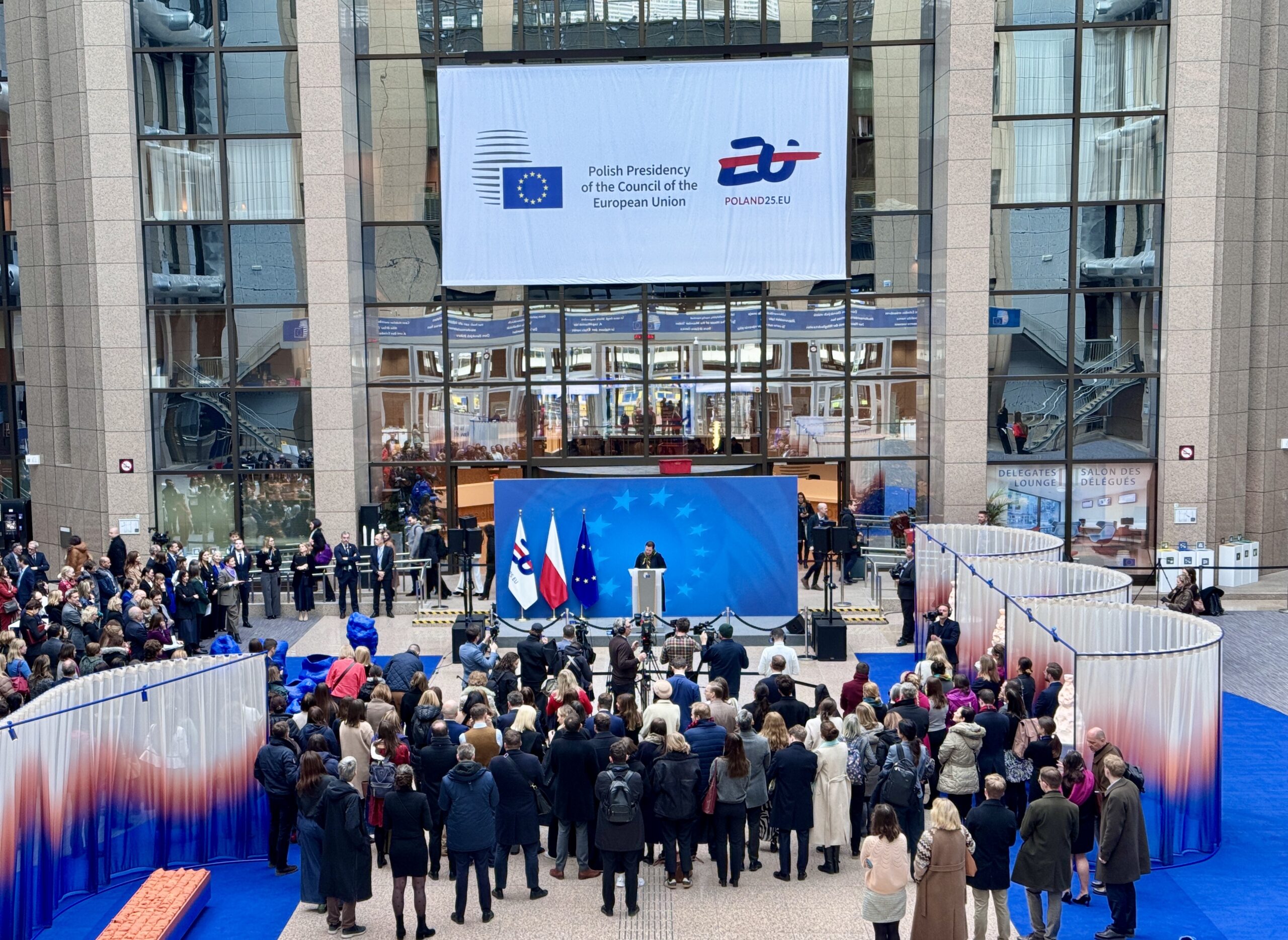
On 1 January 2025, the Polish Presidency of the European Council began and, as last time, in 2011, Poland captivates Europe with its rich cultural programme (more than 100 events in European countries). In the main building of the European Council Justus Lipsius, the exhibition of young Polish artists and designers ‘Regeneration’ (curated by Aleksandra Kędziorek) opened at a gala ceremony, taking over the entire building, including its super modern ‘annex’ of 2016. The organisers of the exhibition deliberately chose young people and moreover, the female part of it. I consider Polish women to be the most beautiful and feminine in Europe (to my taste), many years ago I was a trainee at Telewizja Polska and I have an observation, so this fact did not cause me internal rejection. Especially since the selected artists and designers are talented.
As Aleksandra Kędziorek, the curator of Regeneration, told me: ‘Polish design is characterised by freshness and ingenuity – we can create interesting art objects even with limited resources’. The term ‘regeneration’ comes from the Latin word ‘regeneratio’, which means ‘rebirth’ or ‘restoration’, at the moment – of nature and its resources.
It is this theme that is explored by artist and designer Alicja Patanowska. In the Justus Lipsius Atrium, the young woman presented an art installation entitled ‘We are the weather’. Alicja took the title from the cover of American writer Jonathan Safran Foer’s book We are the Weather: Saving the Planet Begins at Breakfast. In the early 2000s we read his novel ‘Full Illumination’ about the journey of the author’s literary double to the Ukrainian countryside in search of his Jewish roots. Alicia’s installation consists of three interconnected elements that form a narrative about the need for co-operation and solidarity in the face of global challenges. The fountains tell the story of climate change from the perspective of water. Cobalt ‘water catchers’ remind visitors that water is an invaluable resource that must be conserved and protected collectively. The ceramic tile composition forms a visual narrative about the finite nature of this resource.
My favourite of the exhibition is Polish artist Alicja Biała with an installation created using one of the oldest graphic techniques – copper engraving – but updated. On twelve large brass panels Alicja depicted Central European plants with regenerative properties, whose vegetation cycles follow the months of the year. The outlines of human figures appear in the garden they create. The composition becomes a metaphor for harmony and balance in the world, and its mirrored surfaces make every viewer and passer-by reflected in it feel part of this marvellous regenerative garden.
Her installation is installed in the very new European Council building with its huge glass structure in the shape of a luminous cube, inside of which is an oval room called the ‘lantern’.