
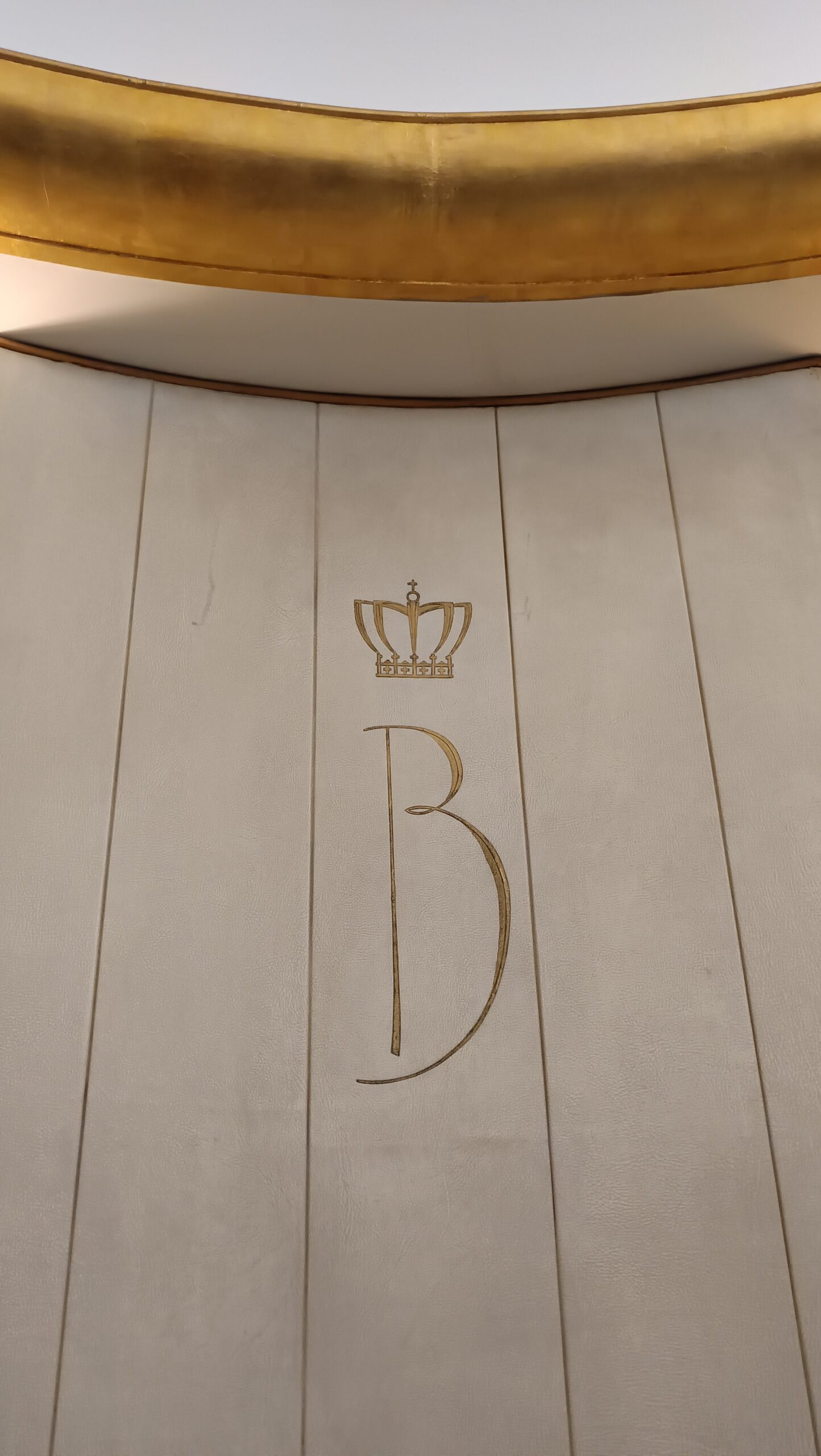
One of Brussels’ Art Deco gems will be available as part of the BANAD festival, which for three weekends in March (15, 22, 29) will open the doors of architecture normally not accessible to the general public. You’ve probably walked past the inconspicuous door with the royal coat of arms 100 times, between the renovated toilet and lift on the middle level of Brussels Central Station. This is the ‘Royal Salon’, the VIP waiting room of, as we would say today, the royal family. A marvellous example of Art Deco high style (not public). Time seems to have stopped here, the noises and sounds of the railway station and eternally hurrying passengers do not reach the luxurious, because of the lack of doors, seeming like a bunker, room. Everything here is made of expensive metals – what is worth white marble (Arabesco), whose slabs with mise-en-scène patterns are filigraphed into real non-man-made panels with gilded veins. Amusingly, under the carpet, a cement floor has been sparingly left instead of marble. In the mysterious island of tranquility among the rushing trains once received international delegations, ambassadors of different countries, conducted secular negotiations. The crucial importance of royalty is emphasised in every detail of the interior. These words are true for 1952, when the Salon was inaugurated together with the Central Station. Today, the royal family flies by aeroplane and passes the time in the VIP lounge at the airport.


As early as 1910 Victor Horta received an order for the Central Station, necessary for the heart of Europe, its railway hub of Brussels, to connect the existing North and South stations. World War I and then World War II put the project on hold. A legendary architect who had passed away was replaced by Maksim Brunfaut, son of the president of the National Railway Bureau. A few years after the opening, the plaque about his authorship of the railway station was replaced by a fair ‘continued the work of Victor Horta’. Since the great architect had designed the Central Station. The son of great rank only completed, albeit honourably, what he had started.
In 2025, BANAD, dedicated to the Art Deco style, will pay special attention to this trend, but also will not forget its ‘sub-blings’: 60% Art Deco, 25% Art Nouveau and 15% Modernism. The festival is organised by Explore.Brussels in collaboration with various associations and partners in Belgium and abroad.