
We admired the rooftops of Brussels from the height of the building on Rue du Lombard 69. We took a tour of the Brussels Parliament with its deputy David Weytsman (MR) and experienced aesthetic pleasure from the architecture and art objects commissioned by the institution in 1998 from 11 artists.
First and foremost, the classical building itself is interesting, completed with a modern roof featuring creatively designed staircases.
In the Parliament hall, there is a light installation by Joseph KOSUTH – lines from the essay collection “Le Double Jardin” by Maurice Maeterlinck (the only Belgian Nobel laureate in literature). Light, both literally and metaphorically, illuminates the symbolic, abstract and open field of thought, essential for the servants of the people.
Terracotta reliefs by Paul DAY, prominently displayed in the Brussels legislative body, are fitting. These reliefs emphasize the search for perspective, often multifocal, curvilinear, and multi-planar. On one side, he depicted the reconstructed area of Berlaymont, the headquarters of the European Commission, contrasting with a street of private houses. On the other side, he portrayed Brussels’ ring road, cluttered with cars and pedestrians.
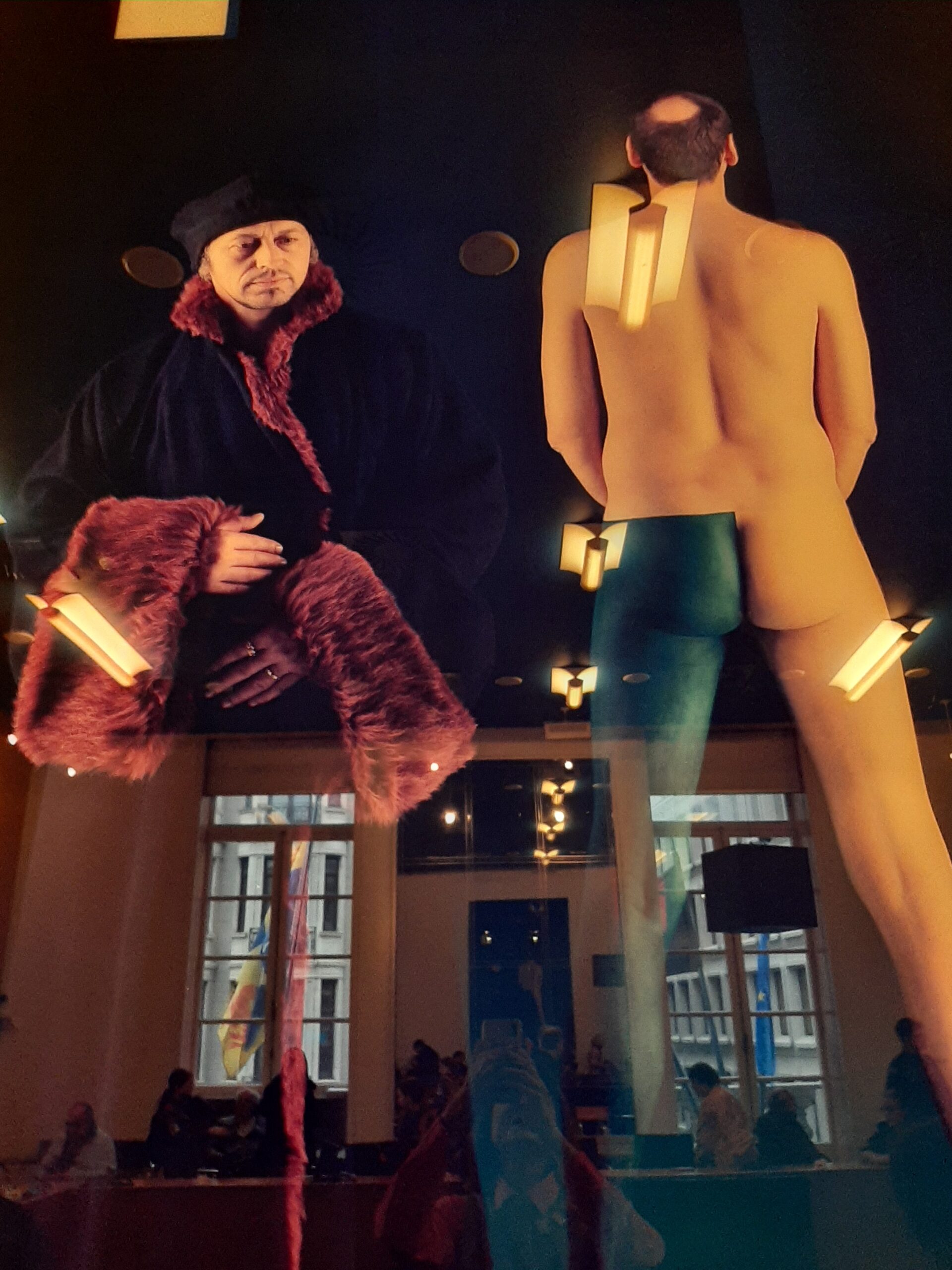
In the meeting room humanism, enlightenment, and democracy are personified by Erasmus of Rotterdam, and apparently, the complexity of achieving them is juxtaposed with a naked man. Artist Michel MOUFFE lets interpretation to the viewer. We did not expect to see such high-level contemporary art revelations in the Brussels Parliament. Does it not distract from making important laws?
However, the installation by the well-known Belgian artist Wim Delvoy, “Lettre d’amour de Mohammed à Caroline,” was most disconcerting. The love letter is written in the Arabic alphabet, the script of which is conveyed by strips of potato peelings. Wim narrates the story of the love between Mohammed and Caroline, the beginning of their passionate relationship, and the painful breakup. In 1997 the Belgian artist was deeply affected by the unrest in disadvantaged neighborhoods in Brussels. The goal of this work was to demonstrate that the Arab world can be connected to Europe through a love story between two different cultures. However, the work sparked a highly controversial reaction, especially among politicians. Who remembers Wim Delvoy’s tattooed pig (including the profile of V.I. Lenin) and that potato peelings are loved by pigs, whose meat Muslims do not eat – the provocative nature of the installation is evident. Nevertheless, it has adorned one of the meeting rooms of the Brussels Parliament since 1998.”


