
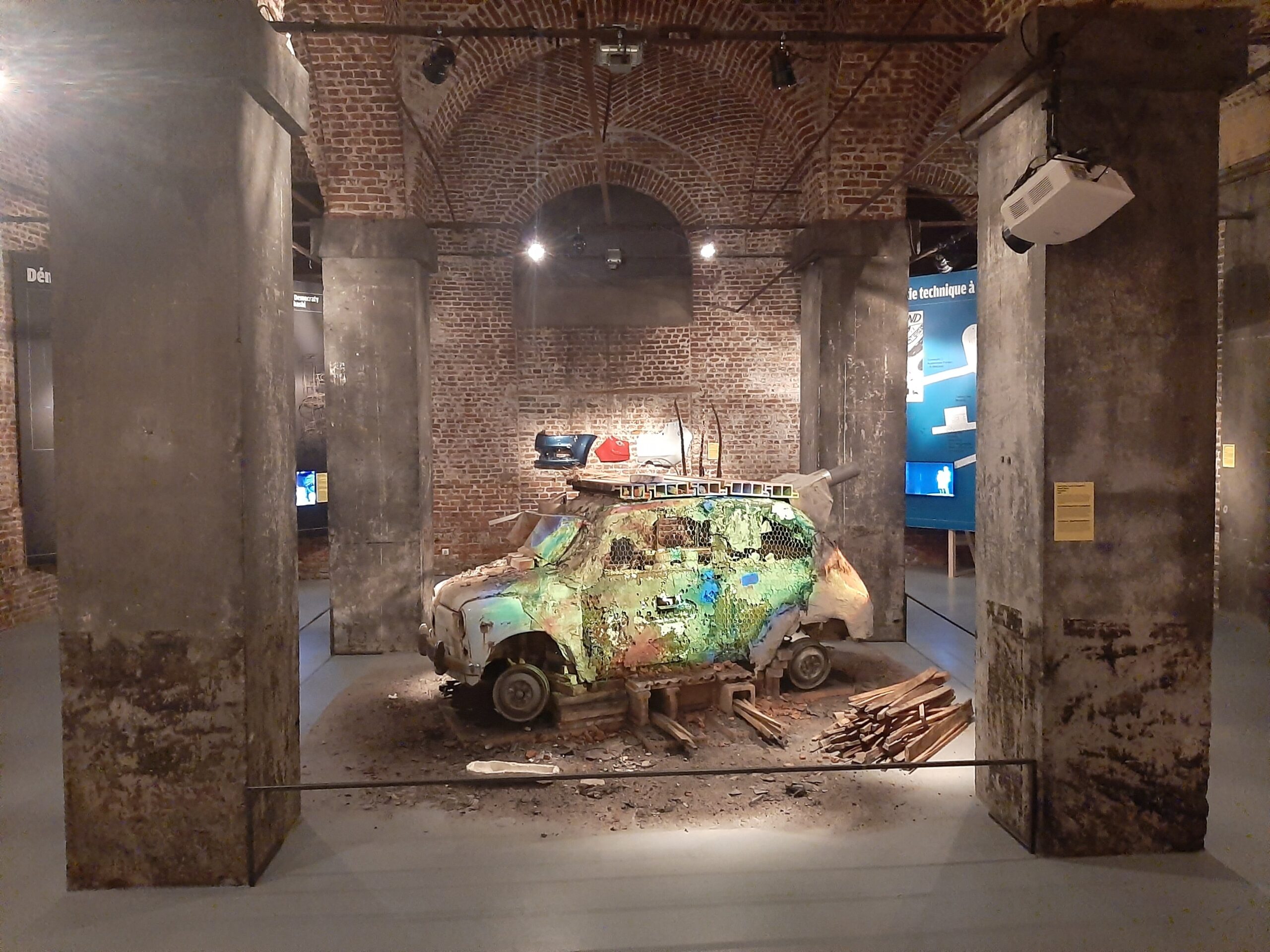
The CID Grand Hornu Centre for Contemporary Design generates super relevant ideas in the process of preparing exhibitions, each one more unusual than the last. To understand its narratives requires time and active brain work. An argument in favour of ‘contemporary art’ against its detractors. In autumn 2024, the CID is proposing an exhibition that treats the car as an art object and calls it ‘Autofiction – The Biography of the Car’. As the Centre’s building is a former mining cluster, the industrial theme is sewn into its DNA and it blends seamlessly into its interiors. The project was first presented at the 12th International Design Biennale in Saint-Etienne in 2022. We were given a tour by the curator and designer Olivier Peyricot himself. Let’s start the engine!


A car is more than just a collection of parts. Every day it looks more and more like a digital device that collects and processes data about our world. Its creation has always required natural resources, which are now becoming increasingly scarce due to mass production. ‘Autofiction’ tells the complex relationship between humans and cars, showing how they create artificial and large-scale systems around us. The story explores the controversy among designers and manufacturers through three interconnected biographical lines.
The first part looks at the car as a data-collecting device, emphasising its role in the digital changes of the 21st century. The second part emphasises how the car has become part of the global crisis of resources such as fossils and minerals. Some manufacturers are looking for more responsible solutions, while others warn of the need for deep societal reform. The third part, using examples from Africa, Cuba and Europe, proposes the idea of a ‘technical democracy’ that would empower society to actively participate in the design of systems such as the car.
My three highlights:
In his short video ‘Essay Auto’, Jukka Silokunnas shows the breathtaking spectacle of the disintegrating auto, ending with the complete disappearance of matter. The artist, gradually erasing the car object, raises the question: will the wreckage of 1.2 billion cars (and there are so many in the world right now) be magically swallowed up by planet Earth, leaving no trace?
Like all girls, and boys too, I loved the pink 2024 Renault R5 Diamant – whose glamorous refurbishment added an electric motor and made it look like a cosy designer flat. The spiralling steering wheel is reminiscent of the Gucci/Versace universe. Designer-decorator Pierre Gonallon proposes to reconstruct old cars in a new, modern way. It is a prototype that allows us to visualise the potential of a huge fleet of used cars.


The winner of the 2019 Bridgestone World Solar Challenge is the ‘Engineer’s Dream’ solar car prototype. Since 2004, the Innoptus Solar team (KU Leuven) has been developing ultra-energy-efficient solar-powered cars. BluePoint is the eighth Belgian solar car. In a 3000km test through the Australian outback, the car consumed the energy equivalent of just 7 litres of petrol.


P.S. An art project in its purest form that gave me conflicting feelings: ‘Ladas’. Cuban artist Eisequiel Suarez superimposes the image of a FIAT 124 transformed in the USSR into a Lada car (1960s) onto passport photos of his compatriots with a characteristically serious expression (no smiling). Under Cuba’s political and economic embargo, this was the only form of private transport available to Cubans. The artist archives this artefact-witness to the political regime. Art project as a strong political anti-Soviet statement.


Our family had such a Lada, the colour of fresh green grass, and I see it, even years later, as a breath of air in the post-Stalin era, when the inhabitants of the Soviet Union, freed (though not entirely) from the morass – were able to touch Western consumerism and afford a car. We often travelled to the countryside – picking mushrooms, ramson and sea buckthorn, to the dacha. My friends‘ parents had such “Ladas”-’Zhiguli’. We drove around Moldova, discovering its magnificent views. To this day, of all landscapes, I still prefer the hilly one.